


In the plastic processing industry, PVC materials are widely used in pipes, cables, artificial leather, films, home soft furnishings and many other fields due to their high cost performance, excellent plasticity and good durability. Many people wonder why PVC products vary greatly — some are hard and rigid, while others are soft, flexible and smooth in texture. The key lies in the addition and proportioning of PVC plasticizers, which are essential industrial additives that modify the physical properties of PVC and expand its application scope.
Pure PVC resin is inherently hard, brittle and poorly flexible. It cannot be easily bent or molded at room temperature, making it unsuitable for manufacturing flexible plastic products. As a crucial modifier, PVC plasticizers penetrate between the molecular chains of PVC resin, weaken intermolecular forces, increase molecular mobility, effectively reduce material hardness, and improve flexibility, ductility and processing fluidity. For the production of all kinds of flexible PVC products, the quality and proportion of plasticizers directly determine the texture, durability, stability and service life of finished products.
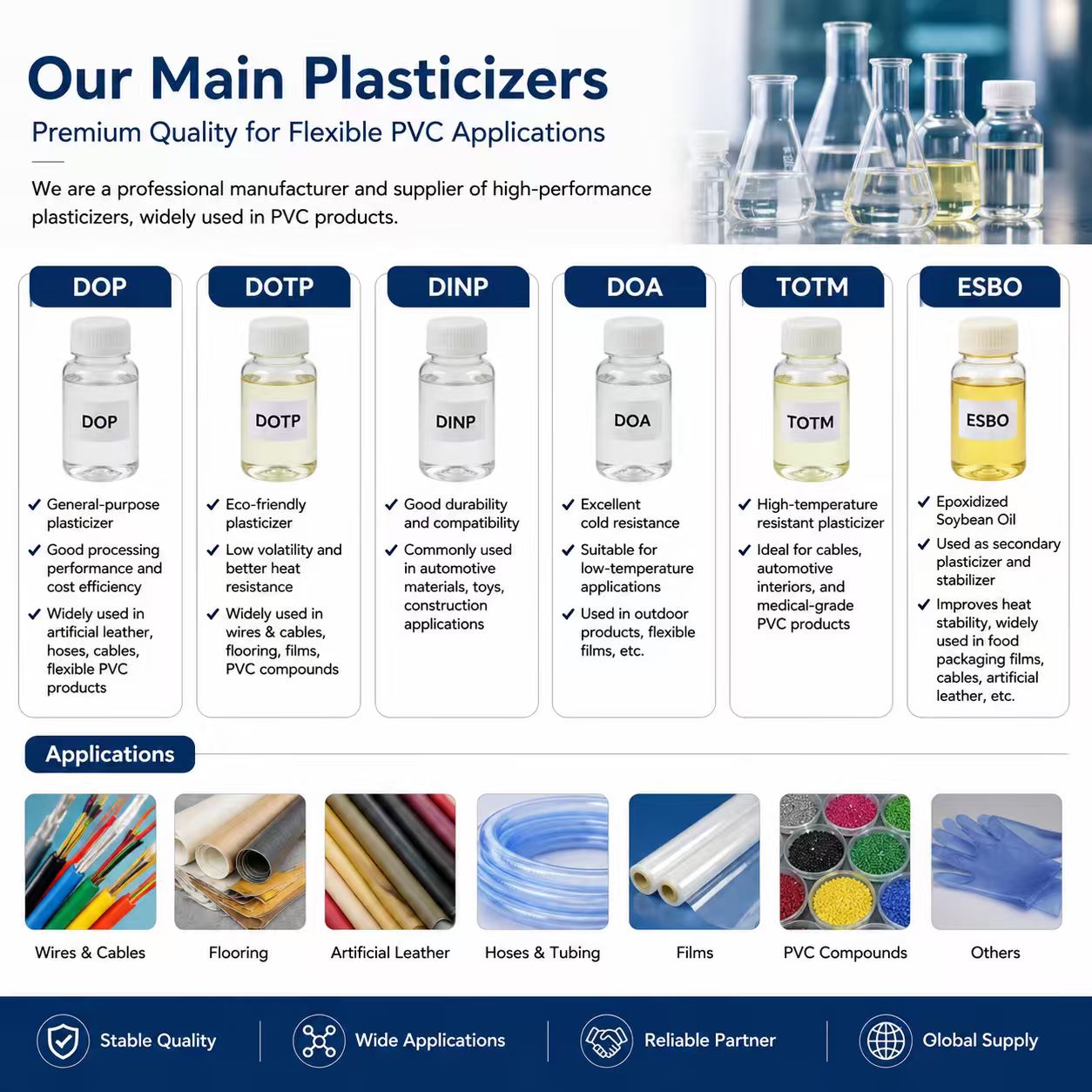
Among various PVC plasticizer products, DOP (Dioctyl Phthalate) is a classic and widely used general-purpose plasticizer with a long application history and excellent universal compatibility in the industry. Featuring high plasticizing efficiency and superior miscibility with PVC resin, DOP can significantly improve the processing performance of PVC materials and endow finished products with ideal softness and mechanical properties at a moderate cost. It has long been widely adopted in the production of ordinary flexible PVC particles, plastic films, wire and cable sheaths, artificial leather, plastic toys and other conventional plastic products, serving as a basic additive in the plastic processing industry.
With the upgrading of environmental standards and industrial technological iteration, DOTP (Dioctyl Terephthalate) has gradually become a mainstream eco-friendly alternative to traditional DOP. As a high-performance terephthalate plasticizer, DOTP overcomes the defects of phthalate-based products, featuring low volatility, low migration, high temperature resistance, aging resistance and excellent electrical properties with outstanding environmental advantages. Compared with DOP, DOTP enables PVC products to have more stable color, less precipitation and longer service life. It is not only suitable for conventional flexible PVC products, but also widely applied in high-standard fields such as high-end cables, medical supplies, automotive interiors and food-contact auxiliary products, becoming a core plasticizer for high and medium-end PVC processing.
High-quality finished products originate from high-quality base materials. The purity, stability and environmental grade ofplasticizer raw materials directly affect the final quality of PVC products. The core difference between high-end and low-end plasticizers on the market lies in the raw material purification technology and formula proportioning. High-quality plasticizer raw materials have few impurities, low volatility and strong compatibility with PVC resin, causing no oil precipitation, no residue and no peculiar smell during processing. They can effectively improve the product’s resistance to high and low temperatures, aging and stretching. In contrast, inferior raw materials tend to cause hardening, yellowing, surface oil precipitation and shortened service life of PVC products, and may even bring potential safety hazards. Therefore, formal PVC processing enterprises strictly select high-quality plasticizer raw materials to guarantee product quality.
Through the scientific proportioning and high-temperature mixing of PVC resin, high-quality plasticizer raw materials and various auxiliary additives, finished Soft PVC Compound can be produced. As a ready-to-use composite plastic raw material applicable to injection molding, extrusion and calendering processes, it requires no secondary proportioning and features convenient processing and stable performance. Soft PVC Compound perfectly combines the flexibility brought by plasticizers and the structural advantages of PVC resin, delivering finished products that are soft, wear-resistant and tough. It is extensively used in flexible plastic products such as plastic hoses, sealing strips, flexible protective sleeves, anti-slip mats and household soft decorations, ranking among the most widely used composite raw materials in the current plastic processing industry.
Throughout the entire PVC processing industrial chain, the modification of basic PVC resin, the selection of qualified plasticizer raw materials, and the targeted application of DOP and DOTP plasticizers jointly form a complete production system for flexible PVC products. Though categorized as auxiliary additives, PVC plasticizers are the key to diversifying the performance of PVC materials and expanding their application boundaries.
As environmental policies become increasingly stringent and market demands for product quality continue to rise, eco-friendly, low-volatility and high-stability plasticizers have become the industry trend. Distinguishing the performance differences between DOP and DOTP, strictly controlling the quality of plasticizer raw materials, and scientifically preparing Soft PVC Compound can not only enhance the market competitiveness of products, but also drive the PVC processing industry toward green, efficient and high-quality development.