


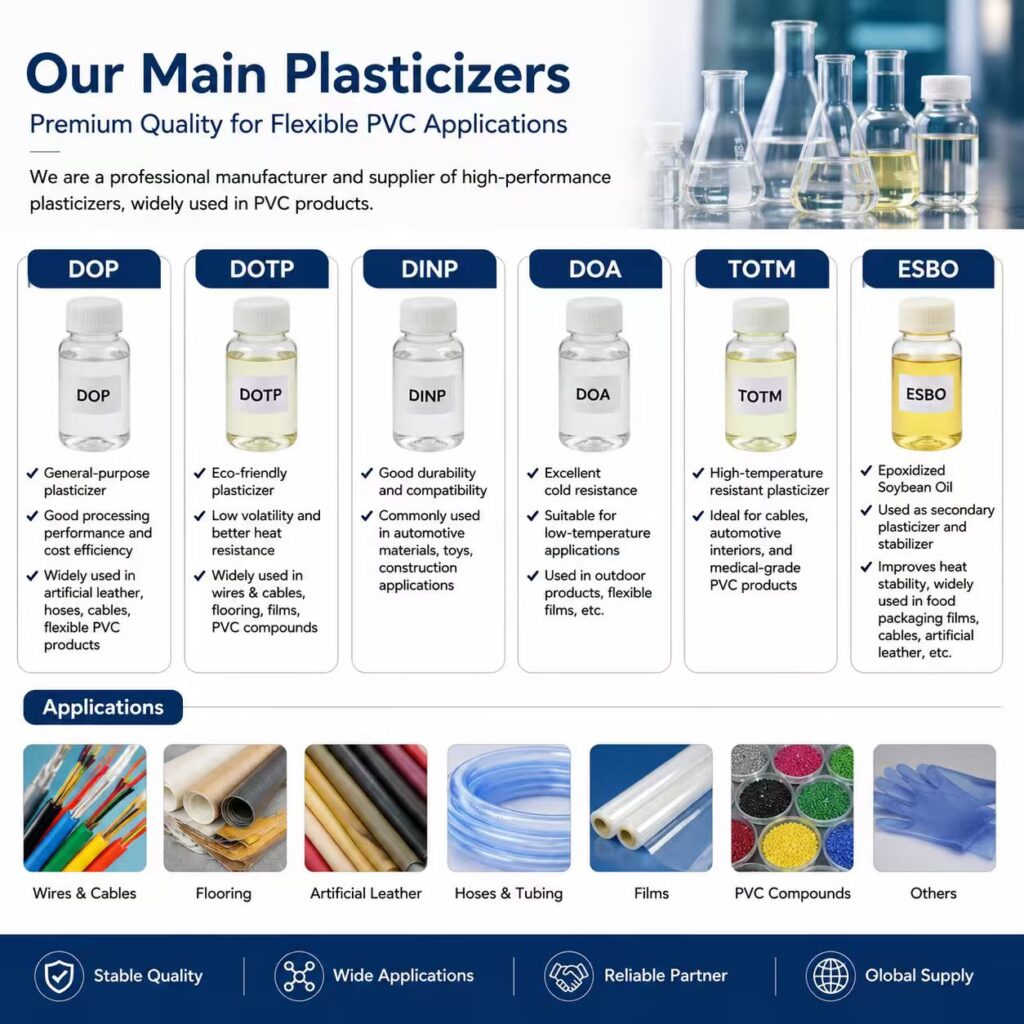
Plastic is one of the most transformative synthetic materials in modern industry and daily life, with a unique superpower no natural material can fully replicate: it can switch seamlessly between ultra-rigid, load-bearing structural forms and soft, flexible, bendable textures that adapt to countless use cases. Most people take this dual personality for granted, but few understand the chemical secret behind this dramatic shift in polymer behavior. The answer lies in a single, indispensable chemical additive: Dioctyl Phthalate, commonly known as DOP. As the most widely used primary plasticizer in the global polymer industry, DOP is the unsung hero that unlocks the full versatility of polyvinyl chloride (PVC), the world’s third-most produced synthetic plastic polymer. It solves the fundamental limitation of pure PVC, turning a brittle, hard-to-process resin into a customizable material that can be rigid as a pipe or soft as a cable insulation layer, all while unlocking unmatched durability and cold resistance.
To understand DOP’s role, we first need to break down the chemical structure of unmodified PVC. Pure PVC resin is a rigid, highly polar linear polymer, with strong intermolecular forces—specifically dipole-dipole interactions and van der Waals forces—tightly binding its long molecular chains together. These powerful attractions lock the polymer chains in a fixed, rigid structure, making pure PVC extremely hard, brittle, and nearly impossible to mold, extrude, or shape using standard industrial processing. On its own, pure PVC has almost no flexibility, cracks easily under minor bending stress, and fails catastrophically in low-temperature environments. It cannot be used for flexible applications like wire insulation, tubing, flooring, or protective sheeting without a critical chemical modifier. This is where DOP, as a primary plasticizer, performs its core chemical function: it safely and effectively weakens the tight intermolecular forces that hold PVC polymer chains in a rigid state.
DOP operates on a perfectly calibrated chemical mechanism that preserves PVC’s core structural stability while rewriting its physical properties. As a non-toxic, high-compatibility primary plasticizer, DOP molecules are small enough to slide between the long, tightly packed PVC polymer chains, acting as a chemical lubricant for the polymer structure. By inserting itself between the PVC chains, DOP physically separates the polar polymer segments, neutralizing the strong intermolecular attractions that cause rigidity and brittleness. This reduction in intermolecular friction does not break or damage the PVC polymer backbone; instead, it gives the long molecular chains free range of motion, allowing them to slide, bend, and flex without fracturing. This single chemical change is what transforms brittle PVC into a fully malleable material, with adjustable flexibility that can be fine-tuned by adjusting DOP dosage—from semi-rigid profiles for construction to ultra-soft, foldable materials for consumer goods.
Beyond delivering customizable softness and flexibility, DOP delivers a suite of synergistic performance improvements that elevate PVC’s usability across global industries. First, it drastically enhances PVC’s thermal and mechanical processing properties, a make-or-break benefit for mass manufacturing. By lowering the glass transition temperature (Tg) of PVC, DOP reduces the heat and pressure required to melt, extrude, mold, and shape the material, cutting industrial energy consumption, extending equipment service life, and enabling high-speed, high-precision production lines. This makes PVC viable for mass manufacturing of everything from medical tubing to automotive interiors, a feat impossible with unmodified PVC.
Most critically, DOP dramatically improves PVC’s low-temperature toughness and cold resistance, a performance feature that defines its use in the most demanding environmental conditions. Unmodified PVC loses all flexibility and becomes dangerously brittle at temperatures just below 0°C, cracking and shattering under minimal stress in cold climates. DOP-modified PVC, by contrast, retains consistent softness, elasticity, and impact resistance even at temperatures as low as -50°C, with no loss of structural integrity or protective performance. This extreme low-temperature stability is non-negotiable for critical infrastructure applications, most notably electrical wire and cable insulation and sheathing.
In frigid, high-latitude regions, where winter temperatures regularly plummet far below freezing, power transmission and electrical systems rely entirely on DOP-plasticized PVC to remain safe and functional. Ordinary cable insulation would harden, crack, and split in extreme cold, exposing live wires, creating fatal electrical hazards, causing widespread power outages, and requiring constant, costly replacement. DOP-modified PVC insulation acts as a permanent, reliable protective barrier: it remains flexible and resilient in sub-zero temperatures, resists cracking from thermal expansion and contraction, repels moisture and chemical corrosion, and maintains stable insulating properties for decades of service. It is the quiet, essential safeguard for power grids, communication cables, outdoor electrical equipment, and underground wiring systems in cold climates across the globe, ensuring uninterrupted power and connectivity in environments where no other plastic modifier can perform reliably.
Unlike low-cost, low-performance secondary plasticizers, DOP offers unmatched long-term stability, compatibility, and durability. It does not easily leach, evaporate, or migrate out of the PVC matrix over time, meaning the plastic retains its flexibility and performance for its entire service life, without becoming brittle, stiff, or degraded. This chemical stability makes DOP the global industry standard primary plasticizer, trusted for critical applications where failure is not an option: electrical engineering, construction, automotive manufacturing, medical devices, and consumer goods.In the end, the dual nature of plastic—its ability to be both rigid and soft, tough and malleable—is not a coincidence of polymer chemistry, but a carefully engineered performance unlocked by DOP. Without this unassuming plasticizer, PVC would be a limited, niche material; with DOP, it becomes the most versatile, widely used plastic in modern infrastructure. DOP turns chemical potential into real-world functionality, giving plastic the adaptability that has made it an irreplaceable foundation of modern life.